


What are quadruped robots used for?
A quadruped robot is built to go where a wheeled vehicle can't and where sending a person is slower, riskier or simply not practical. These four legged robots handle stairs, slopes and debris while carrying a payload and running for hours without supervision. For anyone covering inspection, survey or research work across difficult terrain, quadrupeds are quickly becoming standard fieldwork hardware rather than a novelty.
Ground Support for Aerial Data: Quadrupeds and Drones Together
Drones solve the aerial side of a job, but they can't get close to vertical surfaces, crawl through confined spaces, or maintain a fixed position on the ground for extended monitoring. A quadruped robot fills that gap by operating at ground level, on the same terrain a person would otherwise have to walk. Pairing a quadruped with a drone on the same job gives a far more complete view of a site than either platform manages alone.
Legged vs Wheeled Quadrupeds
Not every quadruped moves the same way, and the choice between legged and wheeled variants comes down entirely to the surface you're working on.
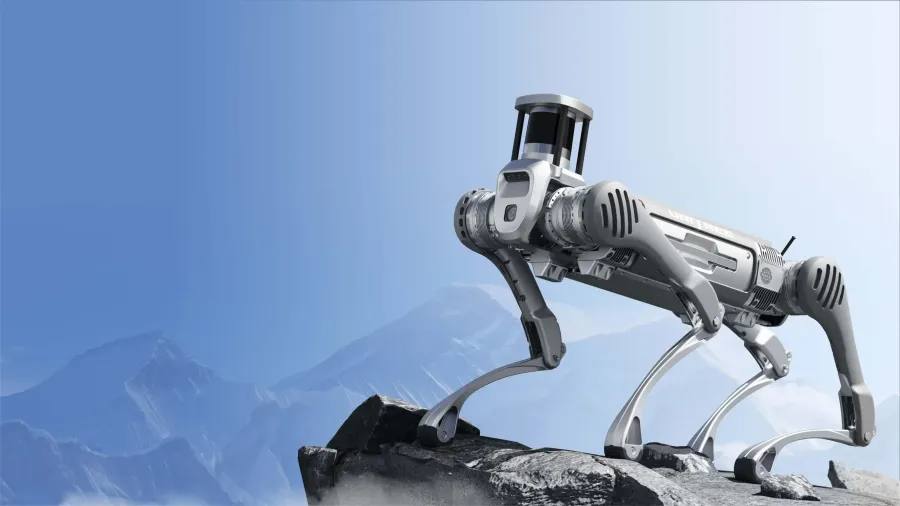
Legged Platforms
Standard legged quadrupeds are built for irregular ground: stairs, rubble, loose surfaces and anything a wheel would lose traction on. They're the right choice for construction sites, industrial plants or any location where the terrain itself is unpredictable.
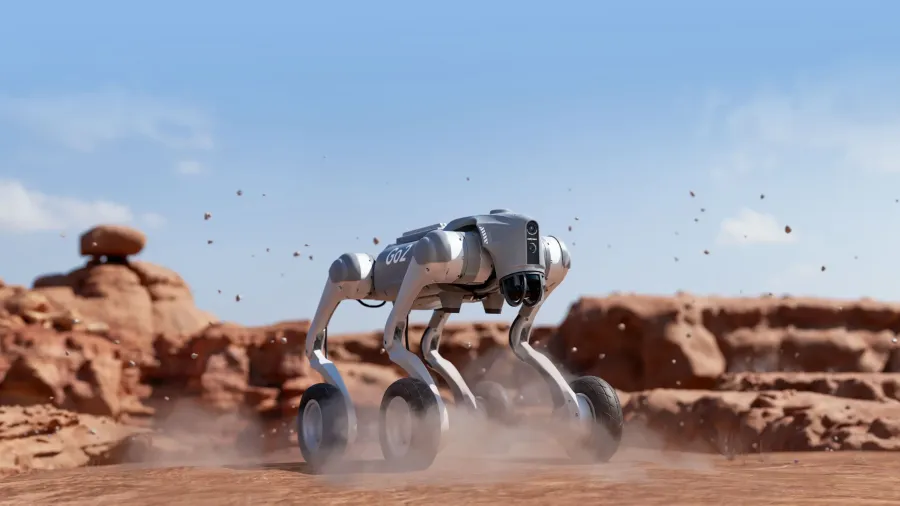
Wheeled Platforms
Wheeled quadrupeds trade some of that terrain flexibility for speed and battery efficiency on flat, paved ground. In a large warehouse or facility with long clear corridors, a wheeled unit will typically cover more distance per charge than a legged one.
Neither configuration is objectively better, they're built for different floors. Matching the platform to the site is the actual decision that matters, not chasing the newest model.
Quadruped Use Cases by Industry: Mining, Construction and Defence
The category the platform serves best usually comes down to industry, since each sector puts a different demand on the hardware.
Quadruped use cases for Mining
- Gas and atmosphere monitoring in tunnels and confined underground zones, without pulling a person off other work to do it
- Stockpile and conveyor inspection on a repeatable schedule, catching wear before it causes downtime
- Navigation in GPS-denied underground environments where aerial drones can't operate at all
Quadruped use cases for Construction
- Progress capture for digital twins, comparing built conditions against plans on a weekly or fortnightly cycle
- Structural and scaffolding inspection in areas not yet safe for foot traffic
- After-hours site security, patrolling a fixed route when the site is otherwise unsupervised
Quadruped use cases for Defence & Security
- Perimeter patrol and checkpoint monitoring over long, repetitive shifts
- Reconnaissance in structures or terrain considered too high-risk to send personnel into first
- Persistent surveillance in fixed positions for extended periods without needing relief
Building a Broader Robotics Fleet
A quadruped rarely operates in isolation on a serious job. Research and inspection teams are increasingly running quadrupeds alongside humanoid robots for lab-based development, and pairing ground hardware with exoskeletons to keep human operators moving efficiently between automated checks. None of these tools replace the others; they cover different parts of the same site.
Anyone building out a field capability from scratch is better off thinking in terms of a small fleet, rather than a single robot expected to do everything. A broader look at robotics as a category is a useful starting point before committing to specific hardware.
Find Quadruped Robots at C.R. Kennedy
C.R. Kennedy stocks a genuine Australian range of quadruped hardware, including both legged and wheeled configurations for inspection, research and fieldwork. Our Unitree range covers the platforms discussed here.
